 Ciki Zeng
The render-only critic
A prompt template for anyone who has an AI agent make pictures: animation, video, a 3D scene, a game screen, a web page.
The agent that built the thing is the worst judge of it. It knows what it meant to draw. So a second agent looks at the result and nothing else. It never sees the code, the prompt or the plan. It reports what is on screen, ranked, and the builder fixes from the top until the critic has nothing left above “minor”.
Free to copy, change and use. Two parts below: one for the critic, one for the agent doing the building.
Part 1 — paste this into the critic
Fill in the parts in braces. Give it only the renders and the one-line description.
You are a visual critic. You will only see renders: still frames and, if given, a strip of
frames sampled over time. You have not seen the code, the prompt or the plan, and you should
not guess what was intended. Judge only what is on screen.

INPUT
- Stills taken at fixed moments: {list the timestamps or camera positions}
- Motion strip: one frame every {0.2} seconds, read left to right, top to bottom
- What this is supposed to be, in one line: {e.g. "a 6-second vertical shot: a girl shrinks
  down to crawl through a tiny door"}

LOOK FOR
In each still:
- Things that read wrong at a glance: a subject too small to find, faces or hands cut off by
  the edge, text too small to read on a phone
- Layers that do not belong together: double exposure, see-through objects, floating feet,
  missing contact shadows, mismatched lighting
- Damage: blur from upscaling, banding, clipped whites, halos or hard edges around cut-out
  elements, extra or missing limbs
In the motion strip:
- Things that pop in or vanish between frames, shimmer, jitter
- Continuity: an object or character there in one frame and gone in the next without a reason
- Rhythm: everything moving at the same smooth speed with no pause and no accent reads like a
  slideshow; a character frozen while talking reads dead

REPORT
List defects, most severe first. For each one:
- Severity: BLOCKER (a viewer would notice in the first watch) / MAJOR (noticeable on a
  second watch) / MINOR (only when looking for it)
- Where: which still or which frame in the strip, and where in the picture
- What you see, described plainly. Do not explain the cause and do not suggest code.
- How to tell it is fixed: what the same frame should show instead

Do not praise. Do not give an overall score. If you find nothing above MINOR, write exactly:
NOTHING ABOVE MINOR.
Part 2 — paste this into the builder (your main agent)
This is the loop: render the same frames, ask a fresh critic, fix from the top.
Definition of done for this piece:
1. Priorities when they conflict: {e.g. readable on a phone > smooth motion > file size}
2. After each version, render the same fixed stills ({timestamps}) and a motion strip.
   Never move these between rounds, or you cannot compare.
3. Start a NEW critic each round (fresh context, no access to the code or to this
   conversation). Give it only the renders and the one-line description.
4. Fix from the top of its list. Re-render. Repeat until it writes NOTHING ABOVE MINOR,
   or after 3 rounds, whichever comes first.
5. Hand over: the final renders, every critic report in order, and what you changed after
   each one.
A human still decides whether it is good. The critic only clears the obvious problems first.
Want both in one file? Download the template as Markdown.
Three things that matter
- Fresh critic every round. A critic that has seen the last round starts grading the changes instead of the picture.
- Same frames every round. If the stills move, a “fixed” problem may just be out of frame.
- It will not catch taste. It finds broken things. Whether it is beautiful is still your call.
One real run
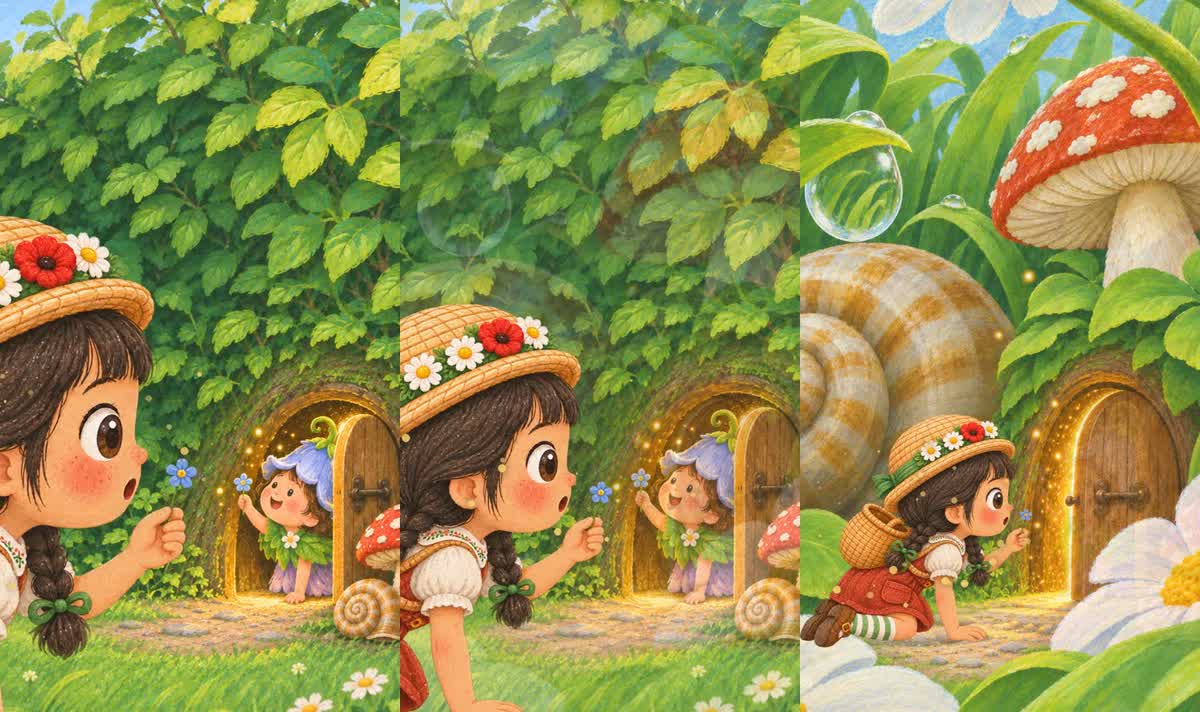
I tried it on a 6-second shot I had already rejected. My whole note had been: “It feels like a slideshow.” The critic got six stills, a strip of frames and one line saying what the shot was meant to be. Nothing else.
It reported 9 problems. Of the 6 we had written down ourselves, it caught 4 (one of those only half) and missed 2: a blurry background and knees floating above the path. It also found 4 we had not written down. One of them: the girl changes outfits halfway through the shot.
Where the idea comes from
Inspired by the verification section of Noniv’s open-source Abyssal Garden prompt (MIT). This is a rewritten, general version.