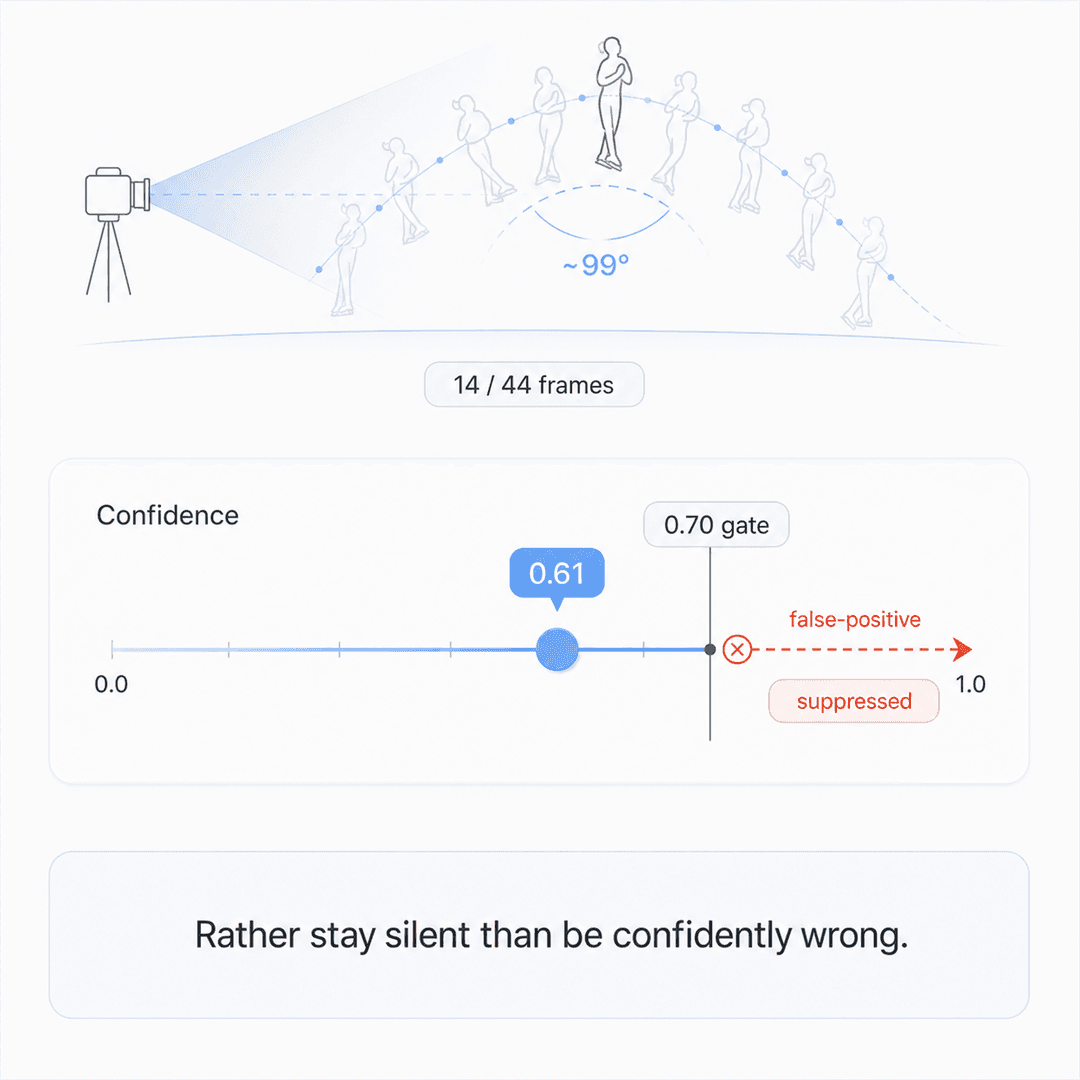
I gave my figure-skating AI the easiest test I could think of: a textbook triple axel from a world champion. A jump you'd put in a coaching manual. If anything on earth was a clean, fully-rotated landing, this was it.
The system flagged it as under-rotated. High confidence on the defect.
I build JumpOnion, an app that analyzes a figure-skating jump from a single phone video. This was mid-development — the world champion's jump wasn't a customer or a test kid, it was how I checked whether the rotation detector was telling the truth or just talking. That one wrong answer is the reason JumpOnion works the way it does today.
How I was testing it
This was the rotation calibration phase. I ran a set of real skating videos through the full system to see where the detector agreed with reality and where it didn't. The world champion's jump was supposed to be the easy "yes." It came back a confident "no."
So I opened up the numbers behind that single call.
single phone angle
A clean jump enters the detector as one flattened camera view.
thin proof
One flattened view couldn't prove what happened in three dimensions.
angle looked wrong
A projection artifact looked like a rotation defect.
Why a single camera lies
The evidence behind that landing was far thinner than the confident verdict suggested. From that one phone angle, the landing simply looked wrong to the system — it read a defect that wasn't there.
It wasn't under-rotated. It was a projection artifact. One camera, the skater's glide direction, and the angle of the blade edge together faked a number that doesn't exist in three dimensions. The jump was fully rotated. The camera just couldn't prove it, and the detector mistook "can't prove" for "didn't happen."
The cheap fix and the expensive one
The cheap fix was to make the system far more conservative about borderline evidence — and I took it. A reading like the champion's no longer produces a diagnosis at all: the app says nothing instead of saying something false.
The expensive fix was the principle I had to commit to: I would rather the app stay silent than be confidently wrong.
That sounds obvious until you watch a product do the opposite. Most analysis tools are built to always have an answer. I decided mine wasn't allowed to, unless it could back the answer up.
A number can look precise while the camera evidence is still thin.
Why silence wins here
Figure skating is a small world. A coach or a competitive skater tries the app once, it tells them a clean jump is broken, and that verdict travels the whole rink by the next practice. So when the app isn't sure, I'd rather it say nothing than risk being wrong in front of the one coach who never comes back.
So here's the rule I shipped: if the system can misread a world champion's textbook jump from a bad angle, then an ordinary kid's half-rotation or a non-standard attempt deserves more caution, not less.I calibrate against the hardest jump I can verify, and when the camera's evidence is thin, the app keeps quiet.
What that looks like in the product
- A rotation call only appears when the evidence genuinely supports it. Anything weaker is worded as an observation, not a verdict.
- Signals I don't yet fully trust stay internal — they never surface as conclusions.
- I calibrate with jumps I can actually check frame by frame — including my own kids', who skate, so I know the ground truth before the model says a word.
The part of JumpOnion that matters most isn't one you can see in a screenshot. It's the answer the app decided not to give.