 Ciki Zeng
This month I gave myself one challenge: enter several big hackathons back to back.
Between October 19 and October 30, I submitted four entries. In the same month, I also moved my whole setup from Windows to a Mac.
Amazon Build, Ship, Shape
Open Agent
Nebius × NVIDIA
Zetaris Demo Challenge
I'm not going to explain what each project does here. Each one has a public page and a repo, linked at the end. This is about what the month was like.
The one that took the most out of me
The Amazon hackathon put JumpOnion, the figure-skating analysis product I've been building since April, on a TV, controlled by a remote and by voice.
Building it wasn't the hard part. Polishing it was. I went back and forth between two different Fire TV sticks more times than I can count, because I wanted everything I published to be responsible: nothing that would mislead anyone, every claim as precise as I could make it.
It was also the most rewarding one. The first time I saw a product I'd spent most of this year on laid out cleanly on a TV screen, I was genuinely excited.
When I wanted to quit
There were a lot of those moments.
01 · WHAT I PICTURED
Alexa voice commands reach my app the way I expected.
02 · WHAT CAME BACK
Not that. Part my own mistake, part still unexplained.
03 · NOT WASTED
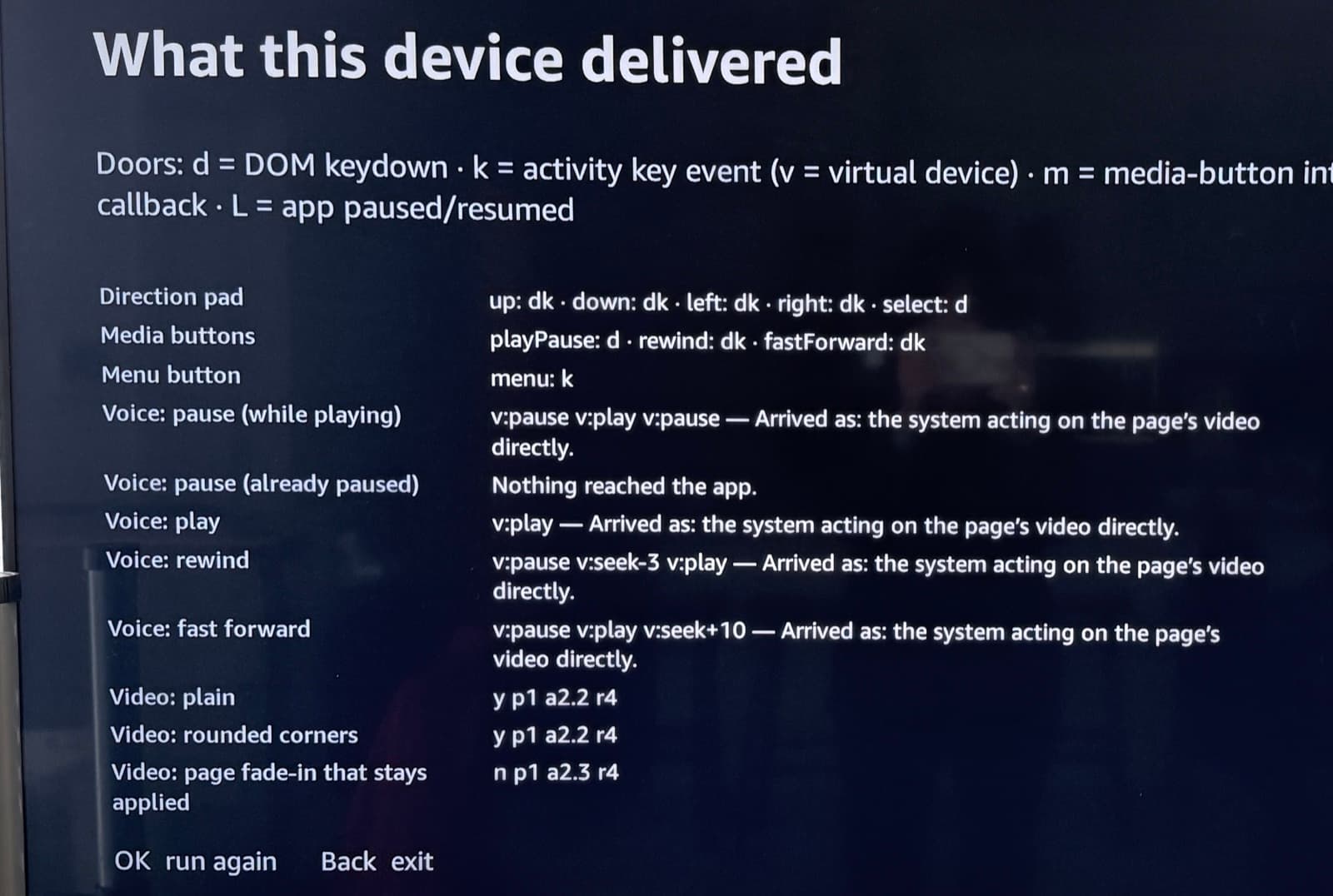
A small probe that shows what the device actually receives.
One of them: Alexa voice commands didn't reach my app the way I expected. Part of that turned out to be my own mistake. Part of it I still can't explain. My first thought wasn't “this failed.” It was “how do I keep this result from being wasted?”
So I built a small probe, an app you install on a Fire TV to see what the device actually receives. The moment it worked, something clicked. The result wasn't wasted anymore. It had become a tool.
Looking back, the urge to quit always came at the same point: when I had pictured the result one way and the real one came back far from it. That's when I'd start wondering whether I had been wrong from the start.
But the wrong turns were worth something too. I wrote each one down as friction, so it would count.
Four in twelve days
While the four submissions were stacking up, the only feeling was: keep going, keep the momentum. I was anxious. But you eat a meal one bite at a time, and I had planned a rough direction for each one before any of them started.
The most anxious moment wasn't my own code. It was finding out that a sponsor's own tool had a defect. Getting my environment to work with the sponsor's isolated environment took a large share of the build time.
I don't think that's how it should be. That time wasn't building. A hackathon exists so people can use their creativity freely. When the barrier just to get started is this high, that purpose changes, and I suspect some people with real ideas drop out before they ever get to them.
What I'd tell myself in September
None of the four have results yet.
So I don't know yet whether I'm on the right road. But no step was wasted. I can take more pressure than I could a month ago, and I'm better at getting through the hard parts. I don't regret the choice, and I took every one of them seriously.